Last Updated on November 26, 2026 by Yogesh Joshi
Key takeaways
- Query fan-out is the step where an AI engine turns one question into several related searches. Google documents it for AI Overviews and AI Mode, and ChatGPT has been observed doing it on a minority of its responses.
- Fan-out queries you have actually logged for your own prompts (observed) and sub-questions you work out from the buyer’s wording (inferred) are different kinds of evidence, so they belong in separate columns.
- A SaaS purchase question usually hides four evidence areas: pricing, integrations, security and implementation. G2 buyer data shows each one is a real source of friction in the deal.
- A fan-out content map assigns every sub-question to one page that can answer it alone, with proof and a label saying whether the sub-question was observed or inferred.
- Query fan-out optimization is mostly about completeness. Google states that no special optimizations are needed beyond its existing guidance, so the work is making sure the answer exists on your site.
Most SaaS teams plan content around the question a buyer types and they treat that one line as one thing to rank for. The buyer sees a short recommendation and comes back but the engine may have turned that line into several smaller searches first and the pages it cites are the ones that answered those smaller searches which are not always the pages that matched the original wording.
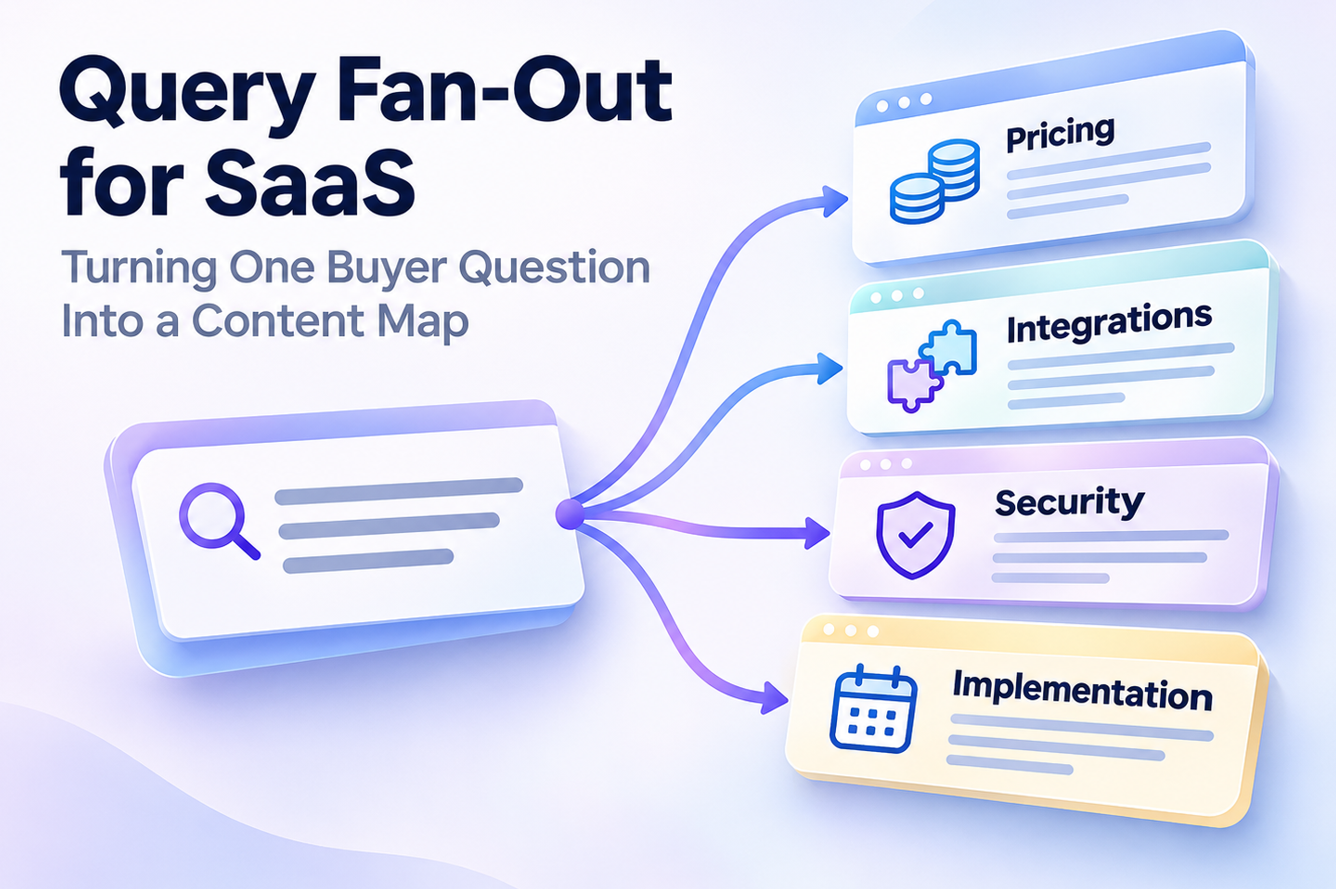
Query fan-out is the step where an AI search system splits one question into several related searches, runs them, and combines the results into a single answer. Google says in its AI features documentation that both AI Overviews and AI Mode may use a “query fan-out” technique, issuing multiple related searches across subtopics and data sources. Query fan-out optimization, for a SaaS company, means mapping one buyer question to the sub-questions it implies and making sure a page on your site answers each one with evidence.
This post covers how to turn one SaaS purchase question into a content map across pricing, integration, security and implementation evidence and how to keep observed queries separate from inferred ones.
Why does one buyer question need more than one page?
Because the buyer is asking for a recommendation and a recommendation depends on several facts, that usually live in different places on your site and inside your company, with different teams. Pricing tends to sit with growth, security with a trust or legal function, integrations with product documentation, and implementation with customer success. A buyer’s question touches all four at once and an AI engine that fans the question out will go looking for all four.
That matters more now because the starting point of software research has moved.
G2’s AI search insight report, based on a March 2026 survey of 1000+ B2B software buyers and decision makers found that 51% start their research with an AI chatbot more often than with Google and 71% rely on AI chatbots somewhere in the research process. If a sub-question has no good answer on your domain, the engine fills that gap from someone else’s page and that someone is often a review site, a competitor’s comparison, or a reseller.
A buyer question is a bundle of smaller questions and each one needs a page that can answer it on its own.
The rest of this post follows that idea in order – what fan-out is and how often it happens, how to keep observed and inferred queries apart, which sub-questions a SaaS purchase question usually contains, how to build the map, and, what each evidence page needs.
Does every AI engine use query fan-out and how often?
No engine does it on every prompt and the rate depends on the engine and how the study was run.
Google describes fan-out as something its AI features “may” use which already signals that it is conditional. For ChatGPT, Ahrefs analyzed 66.6 million free, logged-out responses collected in August and September 2026 and found that 14.4% contained fan-out queries with an average of about 1.6 queries in those responses. An earlier analysis by Nectiv, reported by Search Engine Land, found ChatGPT searching in 31% of the prompts it tested and averaging 2.17 searches per prompt.
The two figures differ because the samples, models, login states and prompt types differ and neither is a SaaS-specific rate. The practical reading is that fan-out is a trigger rather than a given.
GeoRankers refers to this as a search-triggered buyer question – a prompt where the engine decides it needs fresh evidence, which is the kind of prompt where your pages can actually be retrieved. Whether your own purchase questions trigger it is something to check by running them, not something to assume.
What is an observed fan-out query and what is an inferred sub-question?
An observed fan out query is one you have seen in a logged response to a specific prompt whereas an inferred sub-question is one you worked out yourself by reading the buyer’s question and asking what a thorough answer would need to know. Both are useful and they should never share a column without a label.
Observation is possible for some engines. Ahrefs says its Brand Radar AI responses report shows fan-out queries for ChatGPT and Perplexity prompts. Semrush described a manual route in a January 2026 write-up– with Chrome DevTools open on a logged-in ChatGPT conversation, the regular fan-out queries appeared in the network response under a field called search_model_queries. That test used 100 prompts, each run five times to account for variability and field names in a product like this can change, so treat the method as a starting point.
For Google, the documentation describes the technique but does not tell you the queries behind your particular answer, so sub-questions listed for Google are inferred unless a tool shows you the actual queries.
Studies of observed queries give you patterns and patterns are not the same as the queries for your question. In the Ahrefs ChatGPT data, “official” rose from 10.1% to 13.1% of English fan-out queries between August and September, “price” rose from 6.0% to 8.9%, and 6.8% of fan-out queries used a site – operator to search one domain.
Those are real observations but they cover every topic and the most common site – targets were mostly consumer brands, so they hint at how engines look for official and pricing pages without proving anything about your category. The seven query formats Ahrefs lists in its fan-out guide come from analysis of Google patent applications, which makes them a way of thinking about sub-questions, not a record of what any engine ran.
GeoRankers calls the discipline of separating these an observed versus inferred ledger. The ledger has two columns, and every sub-question in the map sits in exactly one of them.
| Label | What it means | Where it comes from | How to use it |
| Observed | The query appeared in a logged response to your own prompt | ChatGPT or Perplexity logs, or a tool that exposes them | Prioritize pages that answer it, and re-check on a schedule |
| Inferred | Your reading of what the buyer’s wording implies | The prompt itself, buyer research, sales and support questions | Treat as a hypothesis until a logged query or a cited page confirms it |
Which sub-questions does a SaaS purchase question usually hide?
Take a hypothetical purchase question – which help desk platform suits a 200-person B2B SaaS company that runs Salesforce and needs SOC 2?
The wording contains four explicit constraints and each points to an evidence area – company size points to pricing and packaging, Salesforce points to integrations, SOC 2 points to security and the idea of a company actually adopting the tool points to implementation. Reading the prompt this way is inference and it should be labeled as such.
The buyer data supports the first of these directly and the other three indirectly. In G2’s survey, the first prompt buyers typed was category-based for 33%, competitor-based for 31%, requirements or process-based for 22%, ecosystem-based for 9% and budget-based for 6%, and understanding pricing and packaging options is among the listed uses of AI chatbots.
G2 does not list integrations, security or implementation as prompt topics, so claiming that buyers ask about them in AI tools would go beyond the data. What the data does show is where deals stall – in G2’s 2026 Buyer Behavior Report, IT security review was the single biggest source of delay, cited by 39% of buyers overall and 50% of enterprise buyers, followed by budget approval at 32% and implementation planning at 25%.
G2 also reports that evaluation is now the longest stage of the buying journey for 40% of buyers ahead of research at 36% and decision at 22%.

We read this as late stage questions arriving early – security, budget and implementation concerns that used to surface in a review meeting can now be put to an AI engine during the first conversation. That is a hypothesis built on where deals stall, and it is the reason these four areas deserve pages before a buyer ever reaches a sales call.
How do you turn one purchase question into a fan-out content map?
This is what we refer to as a fan-out content map – one purchase question, its sub-questions sorted into evidence areas, and a ledger label on each.
It takes five steps and the first three can be done in an afternoon.
Write the question the way a buyer would, constraints included
Use the size, tools, compliance needs and use case that real prospects mention, because those constraints are what the engine fans out on.
Run it and log what you can observe
Run the question in each engine you care about, more than once, because sub-queries vary between runs. Record any fan-out queries that are visible and every URL that gets cited. Tracking the same prompt model by model, with the pages cited and the gaps against competitors, is what GeoRankers is built for, and the map is the planning layer that turns those gaps into assignments.
Write the inferred sub-questions for the four evidence areas
Pull from sales calls, security questionnaires, onboarding tickets and pricing objections, and mark every one that did not come from a log as inferred.
Assign each sub-question to a page, an owner and a piece of proof
One page can answer several sub-questions, as long as each section can be lifted out and still make sense.
Re-run on a schedule and move labels
An inferred sub-question that later shows up in a log becomes observed, and a page that gets cited for it moves from planned to working.
| Evidence area | Inferred sub-question (hypothetical) | Page that answers it | Proof it needs | Label |
| Pricing | What does it cost for a 200-person company, and what is not included? | Pricing and packaging page | Seat ranges by team size, add-ons, onboarding fees | Inferred |
| Integrations | How deep is the Salesforce integration and what are its limits? | Salesforce integration page | Objects synced, sync direction, plan required, setup effort | Inferred |
| Security | Is there a current SOC 2 report and what else is covered? | Security and compliance page | Report type and date, SSO, data residency, sub-processor list | Inferred |
| Implementation | How long does setup take and who does what? | Implementation guide | Timeline ranges by company size, migration steps, customer tasks | Inferred |
Every row above is labeled inferred because it was derived from the sample question, not logged. In a real map, a row moves to observed only when a logged query or a cited page confirms it.
Read – The GEO Guide: georankers.ai/geo-guide
What should each evidence page contain?
Each page should answer its sub-question completely enough that an engine could lift a section and cite it without the rest of the page. That is a design goal rather than a ranking trick since Google states that no additional requirements or special optimizations apply to appearing in AI Overviews or AI Mode beyond its existing guidance.
Pricing: how much does it cost for a company our size?
Ahrefs found “price” rising from 6.0% to 8.9% of English ChatGPT fan-out queries between August and September and G2 reports budget approval delaying 32% of deals.
A page that only says “contact sales” gives an engine nothing to cite – so publish the pricing logic even if quotes need a call.
For a hypothetical help desk vendor, that could be – ” $40 to $70 per agent per month depending on plan, onboarding fee from $2,000, SSO on the top plan only” (placeholder numbers; use your own).

Integrations: how deep does it connect to what we already run?
G2 found that 9% of buyers opened with an ecosystem-based prompt and Ahrefs reports “specifications” entering the top 50 fan-out terms for the first time. Detail matters more than a logo wall – so state what syncs, in which direction and with which limits.
For example, “Salesforce contacts and tickets sync both ways every 15 minutes, custom objects are not supported, requires the Pro plan” (placeholder details).
Security: can we pass our review?
IT security review was the biggest source of delay in G2’s data at 39% of buyers overall and 50% of enterprise buyers.
In Ahrefs’ 20,000 prompt US test, 84.4% of factual prompts cited at least one official source – so a clear first-party page gives an engine something authoritative to cite. State the report type and audit period, SSO support, data residency and subprocessors, for example SOC 2 Type II, audit period January to December 2026, EU data residency available etc. , and leave out anything you can’t back with a document.
Implementation- how long does setup take and who does it?
Implementation planning delayed 25% of deals in G2’s data, so buyers clearly care how long setup takes and who does what. A strong implementation page gives timeline ranges by company size, lists the migration steps in order and splits the work into what your team handles and what the customer must prepare.
For example, for a help desk vendor that could mean adding something like – go live in two to three weeks for teams under 50 agents, four to eight weeks for 50 to 250 followed by the steps and the two task lists.
How do you know the map is working?
Re-run the same purchase question across engines on a schedule and check whether a page on your domain is cited for each sub-question. Citations vary between runs and decay over time – so compare patterns across several runs rather than reacting to one result and treat a page that stops being cited as a refresh candidate.
The content refresh post covers how to decide between updating, merging and creating and the content gaps post shows how to compare your pages’ proof against the pages that win the citation.
For the tracking side of this, see prompt clusters versus keywords.
What can go wrong and who is this not for?
The most common mistake is presenting inferred sub-questions as if engines were known to run them – which turns a planning hypothesis into a false claim. T
The second is publishing one thin page per sub-question which spreads proof across pages none of which is strong enough to cite; one deep page per evidence area with self-contained sections works better.
The third is treating one run as the truth since fan-out varies by run, engine and login state. The approach also assumes your buyers use AI tools for research, which G2’s data supports for software buyers in general but which you should confirm for your own segment, and it fits best when you already have a clear purchase question rather than a broad category.
Conclusion
Query fan-out changes the unit of content planning from the question to the bundle of questions behind it.
For SaaS, that bundle is predictable enough to plan against because pricing, integrations, security and implementation are the areas where deals slow down but it is not known well enough to claim as observed fact. Treat the four evidence areas as a working hypothesis, log what you can see, label everything else as inferred and let the cited pages tell you which parts of the map are doing their job.
Frequently Asked Questions
What is query fan-out in simple terms?
It is an AI engine splitting one question into several related searches, running them, and combining the results into one answer. Google describes it for AI Overviews and AI Mode in its AI features documentation.
Is query fan-out optimization different from SEO?
The fundamentals are the same, since Google says no special optimizations are needed for AI Overviews or AI Mode. The difference is that you plan content at the sub-question level instead of the single keyword level.
Can I see the fan-out queries for my own prompts?
For ChatGPT and Perplexity, yes in some cases: Ahrefs says Brand Radar shows them, and Semrush documented a manual DevTools method for ChatGPT in January 2026. For Google, treat sub-questions as inferred unless a tool shows the queries.
Do I need a separate page for every sub-question?
No. One page per evidence area works if each section can stand alone and carries its own proof. Many thin pages usually dilute the evidence.
How many sub-questions should one map include?
A workable first pass is two or three per evidence area, so eight to 12 for one purchase question. That number is a recommendation, not a researched threshold.
How long until changes show up in AI answers?
There is no published timeline specific to this approach. Re-run the same question on a regular schedule, compare patterns across several runs, and expect results to vary between engines.
What if our pricing is custom?
Publish the logic instead of the number: what drives cost, typical ranges by company size, and what is excluded. That gives engines something to cite while leaving room for a sales conversation.

