Key takeaways
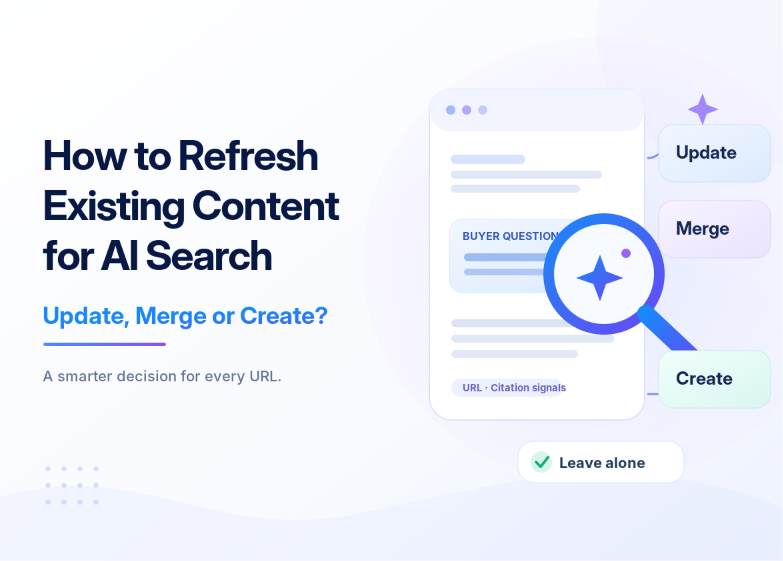
- A content refresh for AI search starts by deciding what each URL should become: an update, a merge, a new page, or no change.
- Four signals decide it: buyer relevance, factual gaps, search performance and observed citation changes.
- The age of the facts on a page, which GeoRankers calls claim age, matters more than its publish date.
- Merge URLs that answer the same question, and create a page only when no existing URL can answer it.
Many teams notice that older posts have stopped appearing in AI answers and respond by sorting URLs by publish date, adding a recent statistic to the oldest ones and changing the date. Weeks later nothing has moved because the pages were chosen by age and not by what buyers and AI engines actually use.
Content refresh for AI search is the practice of deciding, URL by URL, whether a page should be updated, merged with an overlapping page or replaced by a new one and then fixing the facts and structure that determine whether AI engines can cite it. The decision rests on four signals, scored for each URL.
The aim is fewer pages, each answering one question accurately.
Why does refreshing by age or traffic fall short?
Age is a tempting filter because AI assistants do lean newer.
Ahrefs analyzed about 17 million citations and found that cited URLs are 25.7% fresher than organic results, at 1,064 days since publication against 1,432. The same study adds that the average cited page is still nearly three years old and that frequently updating weak pages does little – so freshness only rewards a page that deserves to be cited.
Traffic is no better a guide since it describes classic search and says nothing about whether an engine retrieves a page and trusts its facts. A page with falling traffic can be a steady source in AI answers and a page with healthy traffic can be absent from them because its main claims are out of date.
The third habit is defaulting to new content because it feels safer than editing something that exists. That adds more URLs on the same topics which makes it harder for any one page to be the clear answer and Google’s guidance on generative AI search recommends reducing duplicate content.
What is a better way to choose between update, merge and create?
Refresh a URL because of what buyers and AI engines do with it – not because of how old it is.
GeoRankers refers to this as a refresh triage – each URL is scored from 0 to 2 on four signals and the pattern across them points to one outcome. Each signal answers a different question – whether the page matters, whether it can be trusted today, whether it is likely to be retrieved and whether engines are actually using it so a page that looks fine on one can still fail another.
How do you score the four signals?
Buyer relevance
Start from the questions buyers ask during evaluation instead of from the list of URLs using sales calls, support tickets and the prompts you already track, and map each URL to the one question it is meant to answer. That mapping produces three outcomes – a URL with no question is a retirement candidate, several URLs on one question are a merge candidate, and a question with no URL is a create candidate.
Seer Interactive’s study of 47,097 citations across ChatGPT, Gemini and Perplexity found that comparison, review and brand pages are cited with the freshest update dates – so pages near a buying decision deserve an earlier look. Score relevance 2 when the URL directly answers a buyer question, 1 when it is adjacent, and 0 when it matches none.

Factual gaps
Check every statistic, price, capability and source on the page against its current primary source.
In the same Seer study, among pages with both dates available, 72% looked fresh by update date but only 42% by publish date, so many cited pages are old and kept current. Update the date only after the facts change, since Google’s John Mueller has said that date changes alone do not improve rankings.
Search performance
Rankings still matter because Google says the same SEO fundamentals apply to AI features, but they predict citations less well than before.
Ahrefs found that 38% of cited AI Overview pages ranked in the top 10, down from 76% in a July 2025 study, although the two are not directly comparable. We call this distance between ranking and being cited the rank to citation gap. A page that ranks but is not cited needs its facts and answer structure fixed while a page that is cited but does not rank should be protected.

Observed citation changes
Track a fixed set of buyer prompts per URL across engines and record whether the URL itself is cited.
Seer found that 45% of dated pages were cited in all four months studied and 7% in only one. GeoRankers calls the steady group anchor URLs and they should get careful edits that keep the URL and core answer intact.
Treat changes as directional – allow 3 to 4 weeks, keep a few pages untouched as a baseline and remember the data describes pages and brands, never individual prospects. GeoRankers is built around this tracking and turns the gaps into a list of pages to change.
Read — The AI Content Guide
How do you decide whether to update, merge or create?
| Pattern across the four signals | Decision | Action |
| One URL owns a relevant question and its facts are partly out of date | Update | Fix facts first, add a direct answer, cover follow up questions, then set an honest date |
| Two or more URLs answer the same question and none is clearly cited | Merge | Keep the URL with the best citation and link history, fold in the rest, redirect with a 301 |
| A relevant question has no URL | Create | Build a page around the exact question |
| A URL is cited steadily and is accurate | Leave alone | Check on a schedule and fix only what is wrong |
Pick the merge survivor by evidence with citation history first, then links and rankings and not by age.
Seer concluded that maintaining existing pages beats publishing new ones while the author of the Ahrefs study suspected that new, high quality pages return more than frequent updates to weak ones. The triage reconciles both by refreshing pages that deserve citations and publishing only where none exist.
Inside a refresh, the order of work is facts first, structure second and the date last. Put the direct answer within the first 100 words, phrase headings as the questions buyers ask, and keep the URL unchanged.
What does a refresh look like on one URL?
In a hypothetical example, a B2B software company has two overlapping posts on whether top 10 rankings still lead to AI citations and a third post, an AI search glossary that two engines cite steadily.
Post A has the citation history, so Post B is merged into it and redirected while the glossary is an anchor URL and is left alone.
| Before | After | |
| Headline claim | 76% of AI Overview citations come from the top 10, from a July 2025 Ahrefs study | 38% of cited pages ranked in the top 10 in a larger 2026 analysis, with a note that the studies are not directly comparable |
| Opening | A story first, with the answer in the fifth paragraph | A two sentence answer within the first 100 words |
| Coverage | The headline question only | Adds query fan-out and other assistants, where an Ahrefs study found only 12% of cited URLs ranked in Google’s top 10 |
| Dates | No visible update date | Published and updated dates shown, changed after the edit |
The 76% figure was accurate when published and became a gap only because newer analysis changed the picture, which is why claim age needs a schedule. After 3 to 4 weeks, the team reruns the same prompts and compares Post A with an untouched page.
What should a refresh program start with?
Start with the 10 to 20 URLs closest to buying decisions – score relevance first, fix factual gaps next because they are the cheapest and most common reason a relevant page is not trusted and let search and citation data set the order of work.
Seen this way, AI content optimization is less about new tactics and more about keeping fewer pages accurate.
Frequently asked questions
How often should you refresh content for AI search?
Set thresholds from citation data, not a calendar. Check comparison and pricing pages often, and review evergreen pages when a fact changes or citations drop.
Does changing the published date help AI citations?
Nothing cited here shows that it does. Update dates only after substantive changes.
When should you merge two pages?
When both answer the same buyer question. Keep the URL with the strongest citation, link and ranking history and redirect the other with a 301.
When is a new page better than an update?
When no existing URL can honestly answer the question, or the nearest one answers a different question.
How long until citation changes show up?
It varies by engine and page. Compare the same prompts after 3 to 4 weeks, checking more than once, against untouched pages.
Can you track citations for each URL?
Yes, by prompt and engine over time, but not by prospect, because engines do not reveal who asked. Treat the data as directional.

