Key takeaways
- AI search content gaps are the places where an AI engine cites a competitor page for a buyer question because that page carries evidence yours does not, which makes them a different problem from missing keywords.
- Start from the pages engines actually cite – Ahrefs found that only 38% of pages cited in Google AI Overviews also rank in the top 10 for the same query, so rankings alone will point you at the wrong competitors.
- Read every cited page for the evidence it holds, such as definitions, original data, process detail and third party validation, before deciding anything.
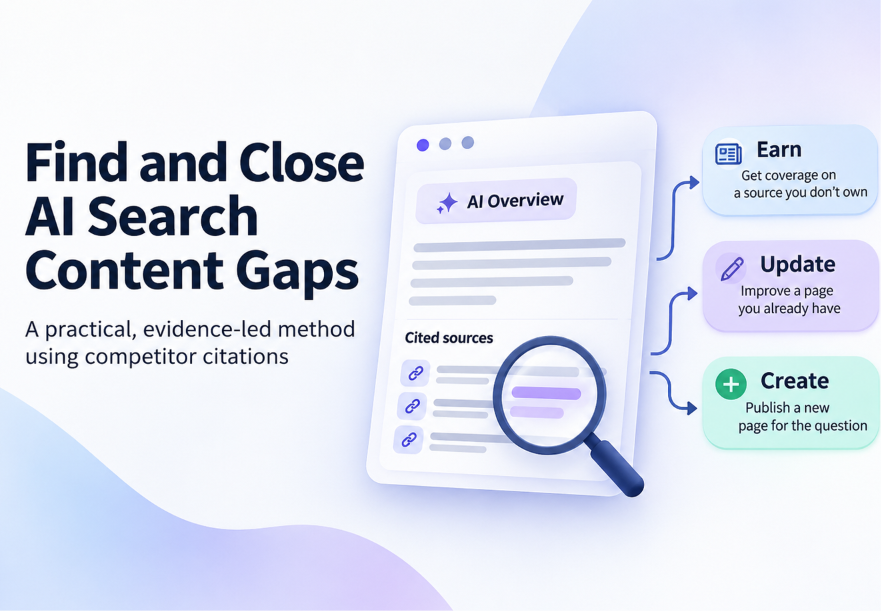
- Each gap leads to one of three routes: update a page you own, create a page that does not exist yet, or earn coverage on a source you do not control.
Most content teams still choose what to write next by looking at what ranks.
A competitor appears above them in a search result, they study that page and then publish something similar with cleaner formatting. In AI answers the same exercise tends to fail because the competitor named as the reference is often cited for a question the team never tracked, on a page that sits nowhere near the first results, next to a review site and a community thread. The team reads the answer, recognizes the competitor and cannot explain why that page was chosen over theirs.
To find AI search content gaps using competitor citations, run the buyer questions in your category through the AI engines your buyers use, list the pages cited in each answer, read those pages for the evidence they contain, and compare that evidence with what your own pages and outside mentions provide. Every difference is a gap, and each gap points to one of three actions: update a page you already own, create a page that does not exist yet, or earn coverage on a source you do not control.
The method works best when a category has a clear set of direct competitors and a manageable list of buyer questions while teams in broad categories should begin with the questions closest to a buying decision. The aim is not to copy what gets cited but to understand what the cited page proves that your own pages do not.
Why do rankings fail to show AI search content gaps?
A traditional content gap analysis compares keyword lists and asks which terms a competitor ranks for that you do not. That logic assumed the page shown to the reader was a page that had won a ranking, and for a while AI answers followed the results page closely.

In July 2025, Ahrefs found that 76% of AI Overview citations came from top 10 pages. Its March 2026 update, covering 863,000 keywords and 4 million AI Overview URLs, put the figure at 38%, with the remainder split almost evenly between positions 11 to 100 and pages outside the top 100.
Two cautions apply before anyone builds a strategy on this data.
Ahrefs improved its parsing between the two studies, so part of the change reflects better measurement and a separate BrightEdge analysis reported by Search Engine Journal found about 17% overlap using a different dataset. The numbers disagree on the exact level but agree on the direction. Ahrefs points to query fan out as a likely explanation, a process in which the engine splits a question into related searches and cites the pages that appear most often across them, which means the page that wins the citation may never have competed for the original query.
This is the distinction we at GeoRankers describe as ranking competitors versus citation competitors. The brands you compete with for positions on a results page and the pages that supply the answer are overlapping groups rather than the same group and a gap analysis built on the first will miss much of the second.
A content gap in AI search is a missing piece of evidence – not a missing keyword!
A keyword gap tells you that a topic exists while an evidence gap tells you why a page was trusted enough to be used in an answer.
A competitor page may be cited because it contains a benchmark nobody else has published, a clear definition near the top, a process described in enough detail to be reused, or because a third party has already vouched for the brand.
Your page can cover the same topic and can even rank for the same term and still lose the citation because none of those proofs appear on it.
How do you build the citation set for one category?
To keep the method concrete, consider a team selling customer onboarding software to B2B SaaS companies.
The walkthrough below is illustrative and built to show the method, so the brand names are placeholders and the findings are not collected data.
The first step is to write the buyer questions the way buyers ask them rather than as keywords. Four questions are enough to begin –
- which onboarding software suits a B2B SaaS company,
- how long onboarding should take for different customer segments,
- how onboarding software differs from a product adoption platform and,
- how to set up an onboarding workflow for enterprise accounts.
Then, run each question in the engines your buyers use, repeat the run a few times because answers vary and log every cited URL with its domain, its page type and the brand it favors.
The reason for casting the net this widely comes from another Ahrefs study of 15,000 long tail queries published in August 2025, which found that on average only 12% of the links cited by ChatGPT, Gemini and Copilot also ranked in the Google top 10 for the same prompt.
Ahrefs explains this with the same fan-out behaviour, noting that assistants tend to favor pages that surface consistently across several variations of a question, so a page ranking around sixth for three related queries can be cited ahead of a page ranking first for only one.
The practical consequence is that the citation set should include the questions around each prompt, not only the prompt itself.
When a buyer asks about onboarding timelines, the engine may also be looking for segment benchmarks, implementation checklists and the cost of a slow start and the pages that answer those are part of your competitive set whether or not they target your keyword.
What should you look for on a cited page?
Reading a cited page is closer to editing than auditing. You are asking what the page proves, in what order and how easy it would be to lift a sentence from it. For each page, record its type, the kind of evidence it carries (a definition, original data, process detail, comparison criteria or third party validation), where that evidence sits on the page, how current it is, and whether the domain belongs to a competitor or to someone else.
Applied to the onboarding example, the four prompts might produce a log like this one –
| Prompt | Cited page | Evidence it carries | What your content lacks |
| Best onboarding software for B2B SaaS | Third party comparison list naming Brand A, Brand B and Brand C | Side by side criteria and reviews from users | No mention on the list or on the review pages it draws from |
| Typical onboarding timelines | Brand A guide | Timeline ranges by customer segment, with the method explained | Your post offers general advice and no numbers |
| Onboarding software versus adoption platform | Brand B comparison page | Decision criteria and a plain statement of when each option fits | No page answers this question |
| Enterprise onboarding workflow setup | Community thread and a video walkthrough | Practitioner detail on what went wrong and how it was fixed | No presence in either place |
The last row is a reminder that the cited page is not always a page in the sense a content team usually means.
In the same Ahrefs update, 18.2% of AI Overview citations that did not rank in the top 100 for the matching keyword were YouTube URLs and YouTube accounted for 5.6% of all AI Overview citations in the dataset. If the proof sits in a video or a thread, the gap is there as well, so the evidence column should record the format along with the substance.
Should you update a page, create one, or earn coverage elsewhere?
Once the evidence is mapped, each gap sorts into one of three routes and the sorting is more mechanical than it first appears.
Update when you already own a page on the question and the difference is evidence rather than existence. In the timeline row, the cited guide wins because it shows ranges by segment and explains how they were derived, so the fix is to add that material to your existing post and to state the direct answer near the top.
An Ahrefs analysis of 17 million citations found that URLs cited by AI assistants averaged 1,064 days since publication against 1,432 days for URLs in organic results, which Ahrefs calls 25.7% fresher with ChatGPT showing the strongest preference for newer pages. The same piece notes that the average cited page is still about 2.9 years old and cautions against changing dates without changing content so the update has to add something real.

Create when no page of yours addresses the question at all. The comparison row is the example, because the cited page exists to help a buyer choose between two categories of product and nothing on your site does the same job. The useful version states when each option fits using the criteria buyers actually apply rather than a feature table that reads like a landing page.
Earn when the cited page lives on a domain you do not own which covers the comparison list and the community thread in the example.
Writing more on your own site cannot close this kind of gap because the evidence the engine is using is someone else saying something about the category. Ahrefs reported in June 2025 that only 7 of the 50 most mentioned websites were shared across AI Overviews, ChatGPT and Perplexity so earned coverage has to be chosen source by source and engine by engine instead of being treated as a single target. In practice earning means giving a publisher or a community something worth citing, such as data, a reviewed profile, or honest participation from someone who has done the work.
This is what we refer to as the route decision – every evidence gap is resolved by updating, creating or earning, and the common mistake is to default to creating because it is the route a content team fully controls.
Some gaps also deserve no route at all, particularly when the prompt sits far from a buying decision. A tracking dashboard can show which pages are cited but the route decision needs the citation set, the evidence and the ownership of each source side by side and that translation from measurement into action is the layer GeoRankers is built to provide as an AI visibility intelligence platform.
Read – The GEO Guide
How often should you repeat the analysis?
Treat the gap list as a working document because the underlying answers do not hold still. Ahrefs describes AI Overviews as probabilistic, with content, citations and fan out queries changing from one query to the next and so a single run is a sample and not a verdict. A workable rhythm is to repeat the same prompt set on a fixed schedule and again after any page you change or coverage you earn, comparing citation sets across runs rather than reading one answer in isolation.
It also helps to be modest about what the data can show. Citation patterns describe a brand and a category, not individual buyers and a link between a content change and a new citation is directional evidence rather than proof of cause. That is enough to prioritize work which is all the method needs it to do.
What does this change about content planning?
Content planning in AI search becomes evidence planning and the question stops being which keywords a competitor ranks for and becomes which proofs the cited pages carry that yours do not and who owns the place where each proof lives.
Gaps on pages you own are updated, gaps in questions you never answered are created and gaps on sources you do not control are earned – in that order of effort for most teams but not always in that order of value.
The teams that benefit most will be the ones that stop copying competitor headings and start reading cited pages for what they prove since a page that wins a citation is usually winning on something specific and checkable.
Frequently asked questions
What are AI search content gaps?
AI search content gaps are the differences between the evidence AI engines find on the pages they cite for a buyer question and the evidence available on your own pages and in outside mentions of your brand. They are usually missing data, missing definitions, missing process detail or missing third party validation, rather than missing keywords.
How is AI citation analysis different from a keyword gap analysis?
A keyword gap analysis starts from rankings and asks which terms a competitor ranks for that you do not. AI citation analysis starts from the pages engines actually cite in their answers, which often do not rank for the original query, and asks what those pages prove. The first compares positions and the second compares evidence.
How many prompts do I need to find AI search content gaps?
A set of 10 to 15 buyer questions is a workable starting point for one category, since it is large enough to show patterns and small enough to read every cited page by hand. Choose questions that sit close to a buying decision, and repeat each one several times because answers vary between runs.
Does a competitor citation mean the competitor page is better?
Not necessarily. It means the page carried evidence the engine could use for that question. Reading the page will usually show whether the advantage is original data, clearer structure, stronger third party support or simply a topic you have not covered, and each of those leads to a different route.
Which AI engines should I include when looking for AI search content gaps?
Include the engines your buyers actually use, and keep the citation sets separate for each one. Ahrefs reported that only 7 of the 50 most mentioned websites were shared across AI Overviews, ChatGPT and Perplexity, so a gap that appears in one engine may not exist in another.
Can I run an AI citation analysis without a dedicated tool?
Yes, for a small prompt set. A spreadsheet with columns for the prompt, engine, cited URL, page type, evidence carried and route is enough to start, though repeating runs across engines becomes slow by hand as the prompt list grows.
How long does it take to see results after closing a gap?
There is no reliable timeline, so measure it instead of assuming one. Repeat the same prompt set after each update, new page or earned mention, and read changes in the citation set as directional signals rather than proof that a single change caused them.


