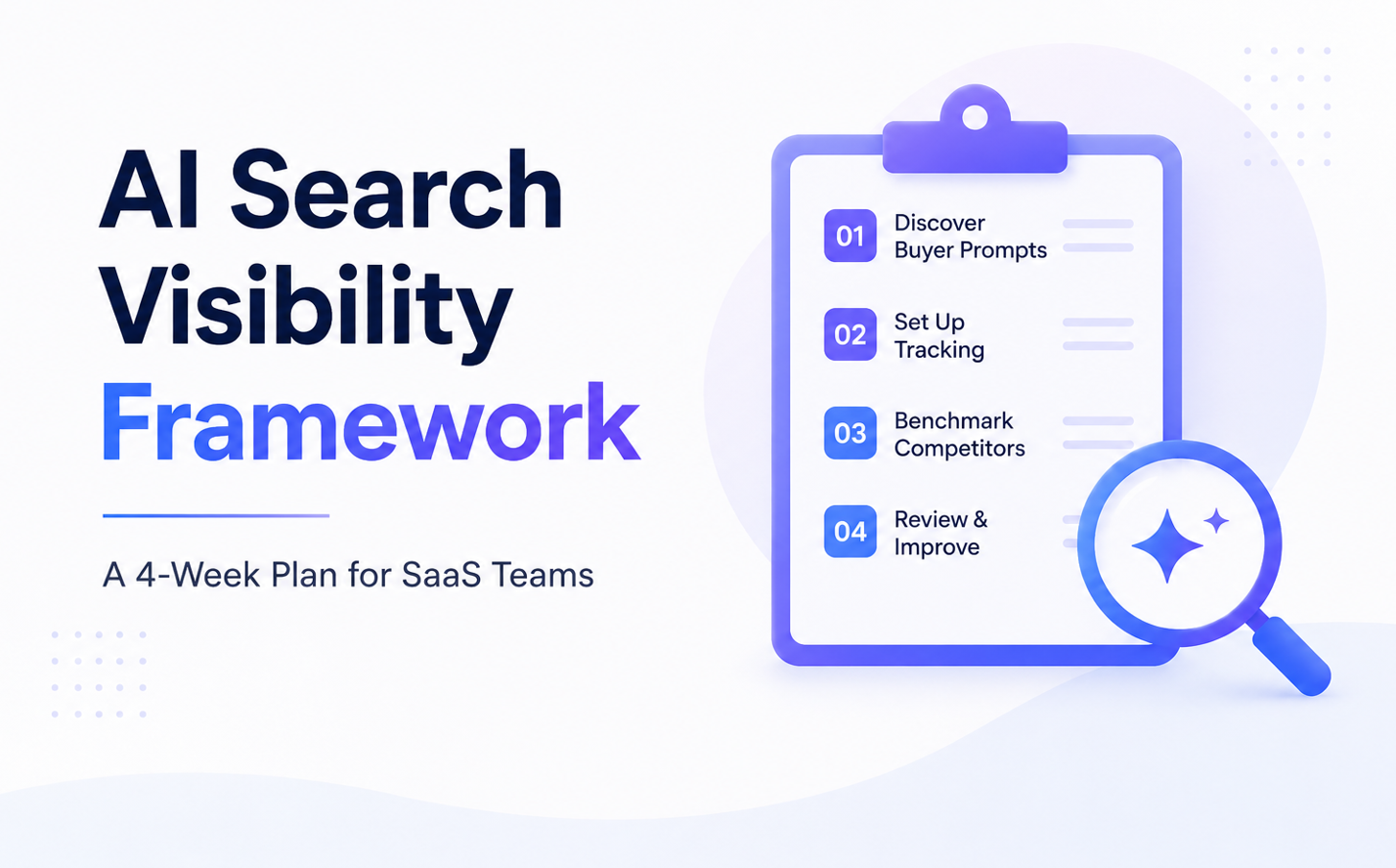
For many mid-market SaaS teams, AI visibility still starts with an occasional search in ChatGPT, Gemini, Perplexity, or Google AI Mode. Someone checks whether the brand appears for an important category or buyer question, notices a few competitors instead, and then moves on because there is no clear process for what to do next.
That is the problem this 30-day AI visibility playbook is designed to solve. It is built for lean SaaS marketing teams with one to three people covering marketing or growth and it shows how to identify the right prompts, set up tracking, run a first visibility audit, benchmark competitors, and create a simple review cadence without adding headcount or building a complicated stack.
Larger SaaS companies may struggle with ownership and prioritization, but smaller teams usually struggle with time. When one or two people are running most of marketing, AI visibility can easily become something that gets checked occasionally but never measured properly.
The goal of this plan is simple – move from ad hoc AI search checks to a repeatable system you can measure and improve within 30 days.

Why 30 Days and Not a Quarter
Most B2B SaaS teams treat something new like this as a quarterly project – write the brief, get budget approved, run a pilot, and then review it in 90 days. That instinct does not work well here and it is worth explaining why before getting into the plan itself.
AI search visibility does not stay put the way a keyword ranking does. Your brand can show up in a ChatGPT answer on Monday and be gone from the same prompt by Thursday with nothing about your brand having actually changed.
G2’s 2026 buyer research found that 51% of B2B software buyers now start their research in an AI chatbot more often than Google, up from just 29% a year earlier. That’s a big shift in a short time and waiting a full quarter to check in means flying blind through the exact stretch when buyer behaviour is moving fastest.
There is also a simpler reason to move in 30 days instead of 90.
You do not need a research department’s worth of tools to get a usable baseline – just a list of prompts, one tracking method set up properly, one audit, and a simple way to see if AI-referred traffic moves along with it even something as basic as a tagged view inside the analytics tool you already use. A small team can get all four done in a month. Just trying to perfect any one of them before moving to the next is usually what kills these projects in week two.
The Mistake Small SaaS Teams Keep Making
Ask a marketing lead at a small SaaS company if they track AI visibility and you will usually hear “not yet, it’s on the list” or “we checked ChatGPT a few times last quarter.” But occasional checks are not tracking – they do not tell you where your brand stands today, what is changing, or whether you are improving over time.
This is not a lack of urgency – it is that AI visibility gets treated like a one-time research question instead of an ongoing process. Someone runs a few prompts by hand, takes some screenshots, writes a short summary and that is where it ends because nobody decided what should happen next.
Compare that to how the same team treats paid search or SEO where there is a standing cadence, a dashboard, someone who owns it and a review meeting on the calendar. AI visibility deserves that same structure – not a one-off audit that goes stale within weeks.
Smaller SaaS companies also have the most to gain from getting this right early and the most to lose by waiting.
Bigger, established brands often show up in AI answers without much deliberate effort simply because they already have years of citations, analyst coverage and review sites behind them. Small companies can sometimes win a narrow niche outright because there is so little competing content that any organized effort stands out. Mid-market SaaS sits in between. There is real competition for category mentions but not yet the years of content and mentions that would make visibility automatic which is exactly why a focused 30 day plan pays off more here than almost anywhere else.

Week One – Identify Your Category Prompts
Week one is not about tools – it is about figuring out the actual words your buyers use when they ask an AI assistant instead of typing into a search bar and building the prompt list you will track for the rest of this plan and beyond.
This step matters more than it looks like it should. Teams that skip straight to a tracking tool often just plug in their own product name and a few obvious competitors and then wonder why the data feels thin. Your tracking is only as good as the prompt list behind it and a list built around your own brand name misses almost everything a buyer actually types before they even know who you are.
Start by splitting your prompts into three types –
Category Prompts
These prompts describe the problem or type of software a buyer is looking for written the way a person actually talks, not the way a product page is written. “Best project management software for a remote team” sounds like something a real buyer would type. “Enterprise-grade collaborative workflow orchestration platform” does not, even if that phrase is sitting on your own homepage right now.
Comparison prompts
These prompts pit your category against named alternatives, usually following a pattern like “X versus Y for [use case]” or “alternatives to [well known competitor] for [company size or industry].”
Evaluation Prompts
These prompts ask an AI assistant to make a judgment call instead of just listing names – things like “what should a 50 person company look for in a [category] tool” or “is [category] worth the cost for a small team.” These show you a different kind of visibility whether your brand’s thinking and ideas show up in how the model reasons through an answer – not just in the list of names it produces.
Aim for 20 to 30 prompts by the end of week one weighted toward category and comparison language since that is usually where buyer research starts.
One good habit is to write each prompt the way you would say it out loud to a colleague – not the way you would type it into a search box. AI assistants respond to natural, conversational phrasing and a prompt that reads like a search query from 2015 will not reflect how your buyers actually talk to these tools today.

Here are a few examples of how you can structure these prompts –
- What are the best [category] tools for mid-market teams?
- Which [category] tools are good for companies with [employee range] employees?
- What are the best alternatives to [top competitor] for a growing team?
- Should we use [your category] or [adjacent category] for [specific use case]?
- How should a [industry] company choose a [category] tool?
- What should a mid-market company look for in [category] software?
- Is [top competitor] worth it for a smaller team?
- What are the best [category] tools for [specific department, e.g. RevOps, growth, GTM]?
Swap the bracketed terms for your actual category and competitors and you have a working list to start with. It will change as you learn more in the coming weeks and it should. Treat week one’s output as a first draft – not a finished document.
Read – for a deeper look at how to build a prompt set around real buyer language instead of old keyword habits, our GEO Guide covers the full method.
Week Two – Set Up Tracking
With a prompt list ready, week two is about finding a repeatable way to run those prompts and record what comes back consistently enough that comparing week to week actually means something.
Manual tracking is where most teams start and that is fine as long as you know its limits. Running your prompts by hand across ChatGPT, Gemini, Perplexity, and Google’s AI features, then logging whether and how your brand shows up is doable at 20 to 30 prompts if you give it a fixed weekly slot. The catch is consistency since AI answers change between sessions and a single manual run only captures one moment, not a pattern. If you go this route, run each prompt at least twice on different days before drawing any conclusions.
Teams that skip this step tend to be the most surprised once they finally measure it. Very few small SaaS teams track this consistently enough to know where they actually stand against their category let alone against specific competitors.
If you would rather not build this into someone’s weekly workload forever, a dedicated tracking platform handles the repetition for you running prompts across models on a schedule and flagging changes automatically. This is where a platform like GeoRankers earns its keep, especially for a small team that cannot spare someone’s Tuesday afternoon every single week. At minimum, the tool should tell you which prompts return your brand, how consistently across repeated runs, which competitors show up alongside you, and which sources the model seems to be pulling its answer from.
Whichever way you go, decide which models you are tracking before you start. ChatGPT still accounts for most AI referral traffic across B2B categories, so it should come first.
BrightEdge’s tracking shows Gemini’s share of AI referral traffic climbing steadily through 2026 and Perplexity matters more than its size suggests for research-heavy B2B buying since it leans so heavily on citations and cross-linked sources. Tracking three or four models from the start gives you a realistic picture instead of a ChatGPT only view that misses a real slice of your buyers.
By the end of week two, you should have a tracking method running on its own – whether that is a shared spreadsheet with a standing weekly task or a platform pulling data on a schedule and the patience to let it run for a week before you draw any conclusions.
Week Three – Run Your First Audit and Benchmark Competitors
This is the week you get your first real output.
With tracking live for several days, week three is about turning raw prompt results into an actual audit – one that shows you where you stand and just as importantly, who currently owns the conversation in your category.
Start with your own numbers. Across your prompt set, what share of prompts returned your brand at all? Of those, how many named you as a real option versus just a passing mention? How many described your product accurately and how many were working off outdated or partial information? That last question catches teams off guard more than any other because AI models sometimes describe features or pricing from a year or two ago and nothing tells you that until you go looking.
Then look at your competitors.
Run the same prompts and note which names show up most consistently. This is not just a list of who else is in your category – it is a map of whose content, documentation, and third-party mentions the models have already learned to connect to your buyer’s question.
SaaS as a category tends to concentrate more at the top than most industries, meaning that a small handful of established vendors soak up a large share of category mentions across most AI engines. That pattern holds even as the specific brands change from one niche to the next which is exactly why knowing who sits at the top of your own category matters more here than in a less concentrated market.
This is where what we at GeoRankers refer to as the visibility floor becomes a useful idea for an exercise like this. The visibility floor is the minimum level of consistent, accurate mention a brand needs across its core prompts before AI-driven discovery starts contributing real pipeline instead of sitting on a dashboard as a curiosity metric. Below that floor, mentions stay too sparse and too random to build any real awareness with buyers. Above it, even modest visibility starts to work the way early organic rankings once did, a small but growing source of qualified interest that costs nothing per click.
Teams running their first audit often find they are below that floor on most of their prompts and knowing that up front changes the goal for month one from “get mentioned” to “cross the floor on your highest intent prompts first” which is a far more realistic target for 30 days.
By the end of this week, write down three things – your baseline mention rate across the full prompt set, the two or three competitors who show up most often and what seems to earn them those mentions, and, the five or six prompts where you are closest to appearing and just need reinforcement rather than a rebuild.
Read – our guide on running a full AI visibility audit walks through the scoring method behind this step in more detail, including how to weigh prompts by buyer intent instead of treating every result the same.
Week Four – Connect Analytics and Establish a Review Cadence
The final week is where this work either becomes a real part of how the company operates or quietly turns back into the one-off audit habit this plan was meant to fix.
Start by connecting whatever visibility data you have now to your existing analytics. If your CRM or analytics tool can segment referral traffic, tag anything coming from ChatGPT, Perplexity, Gemini, or Copilot as its own source instead of letting it fall into “direct,” where it usually gets lost by default. This is worth the setup time.
Ahrefs’ own traffic analysis found that AI search visitors made up just 0.5% of their total site traffic but drove 12.1% of all signups, a difference you only see once that traffic is tagged and separated instead of blending into “direct.” If you cannot see this traffic, you cannot make the case internally that the work from weeks one through three deserves more investment – no matter how real the shift actually is.
It is worth being clear about what this connection can and cannot prove.
AI visibility data, the kind you get from tracking prompts across models, tells you whether and how your brand shows up inside an AI answer – it does not tell you which specific visitor came from which specific mention because most AI platforms do not pass that level of detail through a referrer and the model has no way of knowing which company is asking anyway.
However, what you can build is a directional link – as your mention rate and accuracy improve across your core prompts, does AI-referred traffic move with it over the following weeks. That is genuinely useful for making the case internally even though it falls short of clean, individual-level attribution and being upfront about that difference will save you from overselling the data to a sceptical revenue team later.
Then set your cadence.
Checking every two weeks makes more sense than checking monthly, especially in the first few months. AI models and the content they rely on are changing quickly so a month between reviews can be too long.
Block 20 minutes on the calendar every two weeks with whoever owns content and growth. Look at the same three things each time – has your mention rate changed, are the models describing your brand more accurately, and, has a new competitor started appearing for your core prompts?
Keep the review simple as the goal is to build a habit and not create a detailed report every time. A short recurring check is much more likely to survive a busy quarter than a complicated monthly process.
By day 30 , a small SaaS team following this plan has a prompt set built around real buyer language, a tracking method running without manual effort, a documented baseline against named competitors and a review habit tied to metrics the rest of the company already trusts.
That is a real step up from the screenshot in a Slack channel this plan started with and it does not require a research budget or a new hire to get there.
Where This Fits Into the Bigger Picture
None of this replaces the SEO and content work your team is already doing. AI visibility builds on many of the same signals, such as strong content, clear positioning, useful documentation and third-party mentions. But it still needs its own tracking because AI answers behave very differently from a traditional search results page. If you only check it once a quarter, you will miss the changes happening in between.
The teams that get ahead here are not always the ones with the biggest budgets – they are usually the ones that start measuring early and build a simple, repeatable process around it instead of waiting for a larger initiative.
So the real question is not whether AI visibility matters – for most B2B SaaS companies, it already does. The question is whether your team is still relying on an old screenshot or whether you actually know how your brand is showing up today.
Frequently Asked Questions
1. What is AI visibility tracking?
AI visibility tracking is the practice of monitoring how often and how accurately a brand shows up when buyers ask AI tools like ChatGPT, Gemini, Perplexity, or Google AI Mode about a product category. It usually involves running a defined set of buyer prompts across models on a regular schedule and recording whether your brand appears, how it is described, and which competitors show up alongside it.
2. How long does it take to see results from an AI visibility plan?
A small SaaS team can build a working prompt set, tracking method, first audit, and review cadence in about 30 days. That gets you a baseline and a repeatable process, not guaranteed pipeline. Actual improvement in mention rate and accuracy tends to show up over the following months as documentation, third-party mentions, and content catch up to what the audit reveals.
3. Which AI platforms should a mid-market SaaS team track first?
ChatGPT accounts for most AI referral traffic across B2B categories, so it is usually the first priority. Gemini and Perplexity are worth adding early too, since Gemini’s referral share has been climbing through 2026 and Perplexity carries outsized weight for research-heavy B2B buying because of how much it relies on citations. Tracking three or four models gives a more realistic picture than relying on ChatGPT alone.
4. Do I need a dedicated tool, or can I track AI visibility manually?
Manual tracking works at a small scale, roughly 20 to 30 prompts, if someone owns it on a fixed weekly schedule and runs each prompt more than once to account for variation between sessions. The tradeoff is time. A dedicated platform automates the repetition and is usually worth it once a team cannot spare a recurring block of hours every week to run the same prompts by hand.
5. How is AI visibility different from traditional SEO?
Traditional SEO optimizes for ranking pages on a results page a person scrolls through. AI visibility is about whether and how a brand gets mentioned inside a single, compressed answer that an AI model generates from many sources at once. A brand can rank well on Google and still be missing from AI answers entirely, since the two systems weigh signals differently.
6. How often should a small team review its AI visibility data?
A check every two weeks tends to work better than monthly, at least for the first few months, since AI models and the content around them change quickly enough that a full month between reviews can miss a real shift. A short, consistent 20 minute check-in is more sustainable for a small team than an elaborate monthly report, and far more likely to actually happen.
If you want to follow this plan without building the tracking from scratch, you can try GeoRankers to set up prompt tracking, competitor benchmarking, and analytics connections within the same 30-day plan.


Leave a Reply