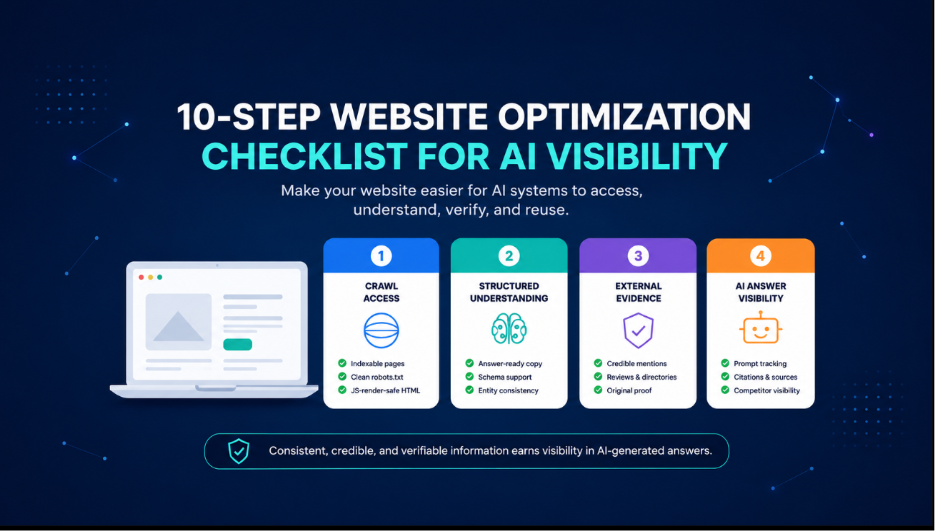
For years, website optimization meant a fairly stable checklist: fix crawl errors, compress images, write title tags, improve internal links, publish useful content, and build authority. That checklist still matters. But it no longer covers the full visibility problem. AI visibility asks a harder question: can ChatGPT, Gemini, Perplexity, and Google AI features find your site, understand your product, trust your claims, and reuse your content inside a synthesized answer?
The best AI visibility work starts by turning your website into a source AI systems can confidently retrieve, parse, and cite. Google has been careful not to describe AI visibility as a separate technical universe. Its guidance says the same foundational SEO best practices remain relevant for AI Overviews and AI Mode, and that pages need to be indexed and eligible for snippets to appear as supporting links. That is the baseline, not the finish line.

AI visibility depends on whether your website works as evidence, not just as a landing page
Traditional SEO optimization is built around ranking a page. AI visibility optimization is built around making your brand usable inside an answer. That difference changes the job of the website. A pricing page is no longer only a conversion asset. It is also a factual source that may be summarized by an AI assistant. A comparison page is no longer only a bottom-funnel SEO play. It is also a structured explanation of how your product fits into a category. A documentation page is no longer only a support asset. It can become the clearest evidence that your product actually does what your positioning says it does.
This is why the checklist below is not a pile of disconnected tactics. The mechanism underneath it is what we can call the evidence access layer: the part of your website that allows machines to access, interpret, verify, and reuse your most important business facts.
Google’s own generative AI guidance points in the same direction. It emphasizes crawlable content, helpful non-commodity pages, clear technical structure, and content organized for readers. It also warns against overfocusing on special AI files, artificial “chunking,” and inauthentic mentions. But Google is only one surface. ChatGPT, Perplexity, Claude, Gemini, and other answer systems differ in how they retrieve content, cite sources, and represent brands. That means the safest optimization strategy is not to chase a single model’s quirks. It is to make your website a better factual source across engines.
1. Your priority pages need to be indexable and eligible for snippets
Start with the boring question because it still decides a lot: can search systems index the page, and can they show a useful snippet from it? For Google AI Overviews and AI Mode, this is not optional. Google states that a page must be indexed and eligible to be shown in Google Search with a snippet to be eligible as a supporting link in those AI features. There are no additional technical requirements, but that does not mean there are no requirements at all.
Audit these pages first:
- Homepage
- Product and feature pages
- Pricing page
- Comparison pages
- Integration pages
- Security and compliance pages
- Documentation pages
- High-intent blog posts
- Glossary or category education pages
Check whether each page is indexable, canonicalized correctly, included in navigation or internal links, and allowed to generate a snippet. Avoid accidentally suppressing the exact content AI systems need with restrictive robots meta tags, blocked resources, or pages that can technically load but provide no useful visible text. The practical test is simple. If a page explains something important about your product, category, pricing, integrations, or credibility, it should be discoverable and summarizable unless there is a deliberate legal or commercial reason to hide it.
2. Your robots.txt file should reflect your AI visibility strategy, not a default template
Many teams still treat robots.txt as a one-time SEO setup. That is risky now because different AI systems use different crawlers for training, search indexing, and live user-requested fetching. OpenAI’s crawler documentation says it uses web crawlers and user agents for product actions, either automatically or triggered by user request, and specifically names OAI-SearchBot and GPTBot robots.txt tags as controls for site owners. Perplexity’s documentation distinguishes Perplexity-User as a user-action crawler that may visit a page when someone asks Perplexity a question and is not used for training foundation models.
Hence blocking every AI-related user agent may protect content from some forms of collection, but it can also reduce your chance of appearing in AI answers that rely on live retrieval. Allowing everything may maximize visibility, but it may not match your content governance policy.
A practical robots review should answer four questions:
- Which crawlers are allowed to access public marketing and documentation pages?
- Which crawlers are blocked from private, gated, or low-value sections?
- Is the sitemap location listed clearly?
- Does the file accidentally block JavaScript, CSS, images, or pages needed to understand public content?
Google’s robots.txt specification says the sitemap directive must be a fully qualified URL and is not tied to a specific user-agent group, meaning it may be followed by all crawlers that support it. That makes the sitemap line a small but worthwhile piece of crawl hygiene.
3. Your sitemap should contain canonical evidence pages, not every URL your CMS can output
A sitemap is not a magic indexing lever. Google is explicit that sitemaps help search engines discover URLs but do not guarantee that every listed URL will be crawled or indexed. Google also says a sitemap is especially useful for large sites, newer sites with few external links, and sites with rich media or news content. For AI visibility, the issue is quality of inclusion. Your sitemap should make the important public evidence on your site easy to discover.
That means including canonical URLs for pages that explain:
- What your product does
- Who it is for
- How it compares with alternatives
- What integrations it supports
- What security or compliance standards it meets
- What pricing or packaging information is public
- What original data, benchmarks, or research you publish
Remove thin tag pages, internal search pages, duplicate parameter URLs, staging paths, outdated landing pages, and broken redirects. If a URL should not be a source for an AI-generated answer, it probably should not be treated as a priority sitemap URL either. Google’s sitemap limits are also worth knowing: a single sitemap is limited to 50MB uncompressed or 50,000 URLs, and larger sites need multiple sitemaps or a sitemap index. Most B2B SaaS sites will not hit that ceiling, but the principle still applies. A sitemap should show crawlers what matters.

4. Your essential content should exist before JavaScript runs
A page can look perfect to a human and still be nearly empty to a crawler. Google processes JavaScript in three phases: crawling, rendering, and indexing. Google has invested heavily in that rendering pipeline, which is why many JavaScript-heavy sites can still perform in traditional search. The problem is that not every AI crawler behaves like Googlebot.
GeoRankers has already covered the rendering divide in detail: many AI crawlers fetch the first HTML response and do not render the full JavaScript experience before evaluating a page. In that failure mode, pricing tables, product copy, comparison details, FAQ content, or documentation loaded only after client-side rendering may be invisible to the systems you want to influence. For AI visibility, the fix is not necessarily to remove JavaScript. The fix is to make the core evidence available in the initial HTML response.
Prioritize server-side rendering, static generation, or hybrid rendering for:
- Homepage and product pages
- Pricing and plan comparison pages
- Documentation and integration pages
- Category and comparison pages
- Research reports and benchmark pages
Test this without a browser. Fetch the raw HTML and ask whether the main product description, headings, pricing facts, FAQs, and internal links are present. If the HTML shell is mostly empty, your AI visibility problem may be technical before it is editorial.
Also Read: AI crawler access on JavaScript websites
5. Your pages need extractable answer blocks near the top
Most marketing pages take too long to say the thing a buyer or model needs. A human may tolerate a narrative build-up. An AI system generating an answer is looking for a concise, attributable statement it can use without reconstructing your entire argument. This is why each important page should include an answer block near the top.
For a product page, that block should say what the product is, who it serves, and what problem it solves. For a comparison page, it should state the factual difference between the two products. For a pricing page, it should describe the plans and billing model without making the reader decode a visual grid. For a documentation page, it should name the workflow, integration, or feature covered. Example structure:
Answer block:
GeoRankers is an AI search visibility platform for B2B SaaS teams that tracks how brands appear across AI-generated answers, benchmarks competitors, and identifies the content or citation gaps that influence recommendation visibility.
That sentence works because it names the entity, category, audience, and function in one place. GeoRankers’ own homepage and features page position the product around tracking brand visibility across AI platforms and turning raw AI model behavior into strategic visibility intelligence. Do this for every page that matters. Not every sentence needs to be compressed but the key claims do.
Read more about AI citation-ready content
6. Structured data should clarify meaning, not stand in for substance
Schema markup is useful but not a shortcut to AI citation. Google says structured data helps Search understand page content by providing explicit clues about meaning, and it can make pages eligible for richer search results. Google’s article structured data guidance also says Article markup can help Google understand title text, images, and date information for news, blog, and sports article pages.
For AI visibility, the right way to think about structured data is semantic support. It helps machines confirm what a page is about and connect entities more reliably. It should match the visible content on the page and describe facts users can actually see.
Use schema where it genuinely fits:
- Organization for company identity
- WebSite and WebPage for site structure
- Article or BlogPosting for editorial content
- Product or SoftwareApplication for software pages
- FAQPage where FAQs are visible and useful
- BreadcrumbList for navigation context
- Person or author markup where expert authorship matters
Avoid adding schema for claims that are not visible on the page. Avoid generic markup that exists only because a plugin auto-generated it. And do not expect schema alone to overcome thin content, outdated claims, or weak external evidence. Google’s AI optimization guide is blunt on this point: structured data is not required for generative AI search, and there is no special schema.org markup needed for Google’s AI features. It remains worth using as part of a broader SEO strategy.
Read: Does schema markup help AI search visibility?
7. Your brand entity should be consistent across every public surface
AI systems do not only read pages. They connect patterns. If your homepage describes your product one way, your LinkedIn page another way, your G2 profile another way, and your old press releases use a category you no longer want to own, the model has to infer which version is true. That is how brands get miscategorized, omitted, or compared against the wrong competitors.
Entity consistency starts on your own site:
- Use the same official company name everywhere.
- Keep one primary category description.
- Make the homepage, About page, footer, metadata, and schema agree.
- Link to verified social and directory profiles from Organization schema.
- Keep author bios consistent across the blog.
- Use the same product naming conventions in docs, pricing, and comparison pages.
Then extend that consistency off-site. Review sites, directories, partner pages, podcasts, webinar pages, marketplaces, and community profiles should reinforce the same category and use-case language. This is unglamorous work. It is also one of the places where AI visibility is won slowly. Models reward repeated, corroborated patterns because those patterns reduce uncertainty.
8. Your site needs original proof that other sources can cite
AI visibility is not only about being understood. It is about being worth referencing. Google’s helpful content guidance says its ranking systems prioritize helpful, reliable information created to benefit people rather than content made to manipulate rankings. That principle maps cleanly to AI search: commodity content is easy to ignore because many sources say the same thing.
The highest-leverage pages on your site should contain proof that competitors cannot copy quickly:
- Original survey data
- Product usage benchmarks
- Customer implementation patterns
- Integration performance notes
- Security documentation
- Migration checklists
- Category taxonomies
- Comparison tables with factual criteria
- Public changelogs
- Methodology sections for any research claim
This is the back half of the work, where many teams lose patience. Treat your website like the control room for a flight path: the aircraft is moving across many systems, but the instruments still need one readable source of truth. The more concrete your proof, the easier it is for journalists, analysts, customers, and AI systems to reuse it accurately.
9. Your off-site mention profile should reinforce the same facts your website claims
Your website can define your product. It cannot, by itself, prove market trust. Ahrefs analyzed 75,000 brands and found that branded web mentions had the strongest correlation with AI Overview brand visibility at 0.664, compared with 0.218 for backlinks. Ahrefs also reported that roughly 26% of studied brands had zero mentions in AI Overviews, while emphasizing that correlation does not equal causation. The strategic lesson is directionally clear: AI systems appear to care about how widely and consistently the web describes your brand, not only how many links point to your domain.
Build off-site reinforcement through:
- Review sites with current product descriptions
- Partner marketplaces
- Analyst mentions
- Guest appearances with transcripts
- Comparison articles
- Community discussions where practitioners speak naturally
- Customer stories on third-party domains
- Industry roundups where your category fit is clear
Do not manufacture low-quality mentions. Google explicitly warns against inauthentic mentions as a generative AI search tactic. The goal is not to scatter your brand name randomly. The goal is to create repeated, credible associations between your brand, your category, your use cases, and your differentiators.
More on backlinks in AI search
10. Your measurement should track AI answers, not only website traffic
Traditional analytics can show you visits, rankings, impressions, and conversions. They cannot fully show whether your brand is being recommended before the click. That matters because AI interfaces can change the user journey before a visitor reaches your site. Pew Research Center analyzed browsing data from 900 U.S. adults and found that about 58% conducted at least one Google search in March 2025 that produced an AI-generated summary; Pew also found users were less likely to click result links when an AI summary appeared. Ahrefs later reported that the presence of an AI Overview correlated with a 58% lower average click-through rate for the top-ranking page in its December 2025 rerun. A website optimization checklist for AI visibility is incomplete unless it includes measurement across prompts and engines.
Instead, track:
- Whether your brand appears for category prompts
- Whether you appear in comparison prompts
- Which competitors appear more often
- How each AI engine describes your product
- Which sources are cited
- Whether cited sources are current and accurate
- Which pages are being retrieved or referenced
- Whether visibility changes after content updates
BrightEdge found that AI Overviews appeared on roughly 48% of tracked queries by February 2026 and that only about 17% of cited sources also ranked in the organic top 10, which reinforces the point that rankings and AI citations are related but not interchangeable. Run this measurement monthly for fast-moving categories and quarterly for slower ones. Use the same prompt set each time so you can see directional change rather than isolated anecdotes.

A practical scorecard makes the checklist usable
A checklist fails when every item looks equally important. Score each priority page against four dimensions:
Access: Can crawlers reach, render, and index the page?
Interpretation: Can a machine identify the entity, category, topic, and key claims?
Evidence: Are the claims specific, current, sourced, and reinforced off-site?
Measurement: Do you know whether the page or brand appears in relevant AI answers?
Use a simple scoring model from 0 to 2 for each dimension. A score of 0 means the page fails the dimension. A score of 1 means it partially passes. A score of 2 means it is strong enough to trust. A product page with a score of 8 is probably ready for active AI visibility work. A page with a score of 3 does not need more promotion yet. It needs repair.

Check out GeoRankers – AI visibility intelligence system
The real optimization decision is whether your website tells one verifiable story
AI visibility will tempt teams into chasing every new acronym, crawler, model, and markup format. Some of those details matter. Many will change. The durable question is simpler: does your website give AI systems a coherent, current, and verifiable explanation of who you are, what you do, who you serve, and why the market should trust you?
That is the work behind this checklist. Crawlability opens the door. Rendering lets the page be read. Structure helps the facts get extracted. Schema clarifies the entity. Original proof gives the page citation value. External mentions confirm that your claims are not only self-description. Measurement shows whether the system is responding.
The companies that win AI visibility will not be the ones with the most elaborate hacks. They will be the ones whose public evidence is easiest to find and hardest to misread.

Frequently Asked Questions
1. What is a website optimization checklist for AI visibility?
A website optimization checklist for AI visibility is a practical audit of whether AI systems can crawl, understand, trust, and reuse your website content inside generated answers. It covers technical access, sitemap quality, robots.txt policy, JavaScript rendering, structured data, answer-ready content, entity consistency, external mentions, and prompt-level measurement. The goal is not only to rank pages in Google, but to make your brand eligible to appear in answers from Google AI features, ChatGPT, Gemini, Perplexity, and similar systems.
2. Is AI visibility optimization different from SEO?
AI visibility optimization overlaps with SEO but is not identical to it. Google says foundational SEO best practices remain relevant for AI Overviews and AI Mode, and indexed pages eligible for snippets are still the baseline for appearing as supporting links. The difference is that AI systems synthesize answers, compare brands, and cite selected sources, so teams also need to optimize for extractable claims, entity consistency, third-party mentions, and prompt-level visibility.
3. Does schema markup help with AI visibility?
Schema markup can help AI visibility indirectly by making page meaning clearer to search systems, especially in Google’s ecosystem. Google says structured data gives explicit clues about page meaning and can make pages eligible for rich results, but its generative AI guidance also says structured data is not required for AI features and no special schema is needed. Treat schema as a clarity layer, not as a substitute for useful content, crawlable pages, current facts, or trusted external references.
4. Why do JavaScript websites sometimes struggle with AI crawlers?
JavaScript websites can struggle when important content only appears after client-side rendering. Google processes JavaScript through crawling, rendering, and indexing, but many AI crawlers do not behave like Googlebot and may rely heavily on the first HTML response. If pricing, product descriptions, FAQs, or documentation are missing from that initial response, the page can look empty or incomplete to the crawler even though it looks polished to users.
5. How often should a company audit AI visibility?
Most B2B SaaS teams should audit AI visibility at least quarterly, and faster-moving categories should check monthly. The audit should repeat the same buyer-intent prompts across major AI systems and track brand presence, competitor presence, description accuracy, cited sources, and changes after website updates. Traditional SEO reporting is still useful, but it does not show whether an AI assistant recommends your brand before the visitor reaches your site.
6. Do backlinks still matter for AI visibility?
Backlinks still matter, but they are no longer the whole authority story. Ahrefs found that branded web mentions correlated more strongly with AI Overview brand visibility than backlinks in its 75,000-brand analysis, while also noting that correlation does not prove causation. A practical AI visibility strategy should keep strong SEO fundamentals while also earning credible third-party mentions, review coverage, community references, and citations that reinforce the same category narrative.
7. What pages should be optimized first for AI visibility?
Start with the pages that define how buyers and AI systems understand your company: homepage, product pages, pricing, integrations, comparisons, documentation, security, About, and high-intent educational content. These pages should be crawlable, internally linked, present in the sitemap, readable without client-side JavaScript dependency, supported by structured data where appropriate, and written with clear answer blocks near the top. Once those pages are strong, expand into research, benchmarks, and third-party citation assets.


Leave a Reply